Bentley Continental GT Supersports Convertible: The Headless Heavyweight
 Liam Campbell
3 minutes read
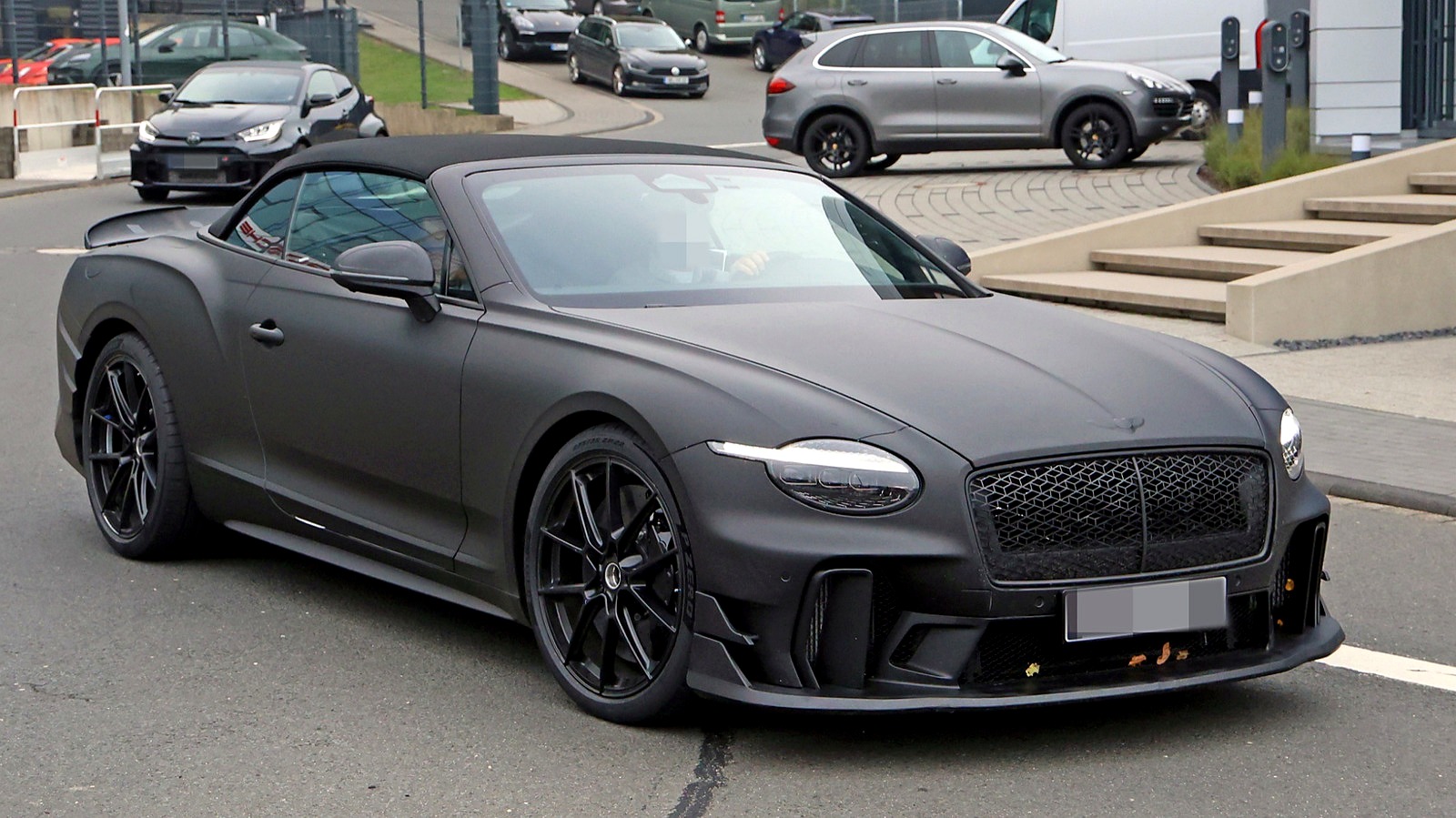
The Bentley Continental GT Supersports is about to lose its roof. Our spy photographers have captured the most hardcore convertible variant testing in matte black, and it’s a dead ringer for what Bentley will unveil at the Los Angeles Auto Show this November. According to a recent report by CARSCOOPS.COM, this isn’t just another soft-top luxury cruiser, it’s a calculated assault on Porsche’s 911 GT3 Cabriolet territory.
*Photos courtesy of SH Proshots.*Rear-Wheel Drive Rebellion
Here’s where things get genuinely interesting. The Continental GT Supersports convertible marks the first rear-wheel drive Continental in 23 years. Bentley ditched the hybrid hardware, the front differential, and the driveshafts entirely. That’s a seismic shift in platform strategy, and it signals something profound: performance now trumps power output in Crewe’s calculus.
The coupe version already proved this philosophy works. All 500 units sold out despite commanding $490,150, roughly $140,000 more than a Continental GT Speed. The convertible will likely breach $500,000, yet Bentley expects to replicate that 500-unit production run. That’s confidence bordering on audacity.
| ⚙️Engine / Powertrain | 4.0L Twin-Turbo V8 |
| 🐎Power Output | 657 HP (666 PS) |
| ⚡Peak Torque | 590 lb-ft (800 Nm) |
| ⏱️0-60 mph (0-100 km/h) | 0-60 mph in 3.4s (est.) |
| 🚀Top Speed | 190 mph (305 km/h) |
| 🔄Drivetrain / Gearbox | 8-Speed Dual-Clutch / RWD |
| 💰Starting Price / Est. | $500,000+ (est.) |
The Weight Diet Pays Dividends
Swapping the aluminum roof for carbon fiber and deleting the rear seats contributed to an almost 1,000-pound weight reduction on the coupe. The convertible won’t be quite as featherweight, there’s a 390-pound penalty versus a standard Continental GTC, but it should still feel nimble by Bentley standards.
The 4.0-liter twin-turbo V8 produces 657 horsepower and 590 lb-ft of torque through an eight-speed dual-clutch gearbox. Yes, the hybrid Continentals make 771 horsepower. Still, anyone buying a Supersports understands the trade-off: less straight-line velocity, more cornering aggression. The full-length Akrapovic titanium exhaust ensures you’ll hear every combustion event.
Design Language Screams Intent
Visually, the prototype wears its aggression like armor. A distinctive grille, deep front splitter with massive side air intakes, and double dive planes frame the nose. Along the flanks sit wider track geometry, big sill extensions, and an integrated rear diffuser. A large single-piece spoiler crowns the trunk lid. This isn’t a Continental GT with cosmetic tweaks, it’s a Continental GT that’s been to the gym and picked a fight.
The tire choice matters too. Pirelli P-Zero rubber comes standard, but Bentley offers the more extreme Trofeo RS for track work. That’s a nod to the car’s engineering DNA, which traces back to Dr. Frank-Steffen Walliser, the CEO who previously headed Porsche’s 918 Spyder project. If Porsche can build a GT3 Cabriolet, Bentley’s logic goes, why can’t we?
The 2026 Bentley Supersports represents a philosophical pivot toward driver engagement over hybrid complexity. When the convertible arrives this fall, expect it to redefine what luxury performance means in an era of electric transition. Bentley’s betting that 500 collectors will pay half a million dollars to hear a V8 sing and feel a chassis respond with surgical precision.
Liam Campbell
Industry Intelligence & News Editor at Auto News Magazine. Tracking prototype spy shots, Nürburgring development mules, automaker corporate moves, and breaking global automotive scoops.
View all articles by Liam Campbell →