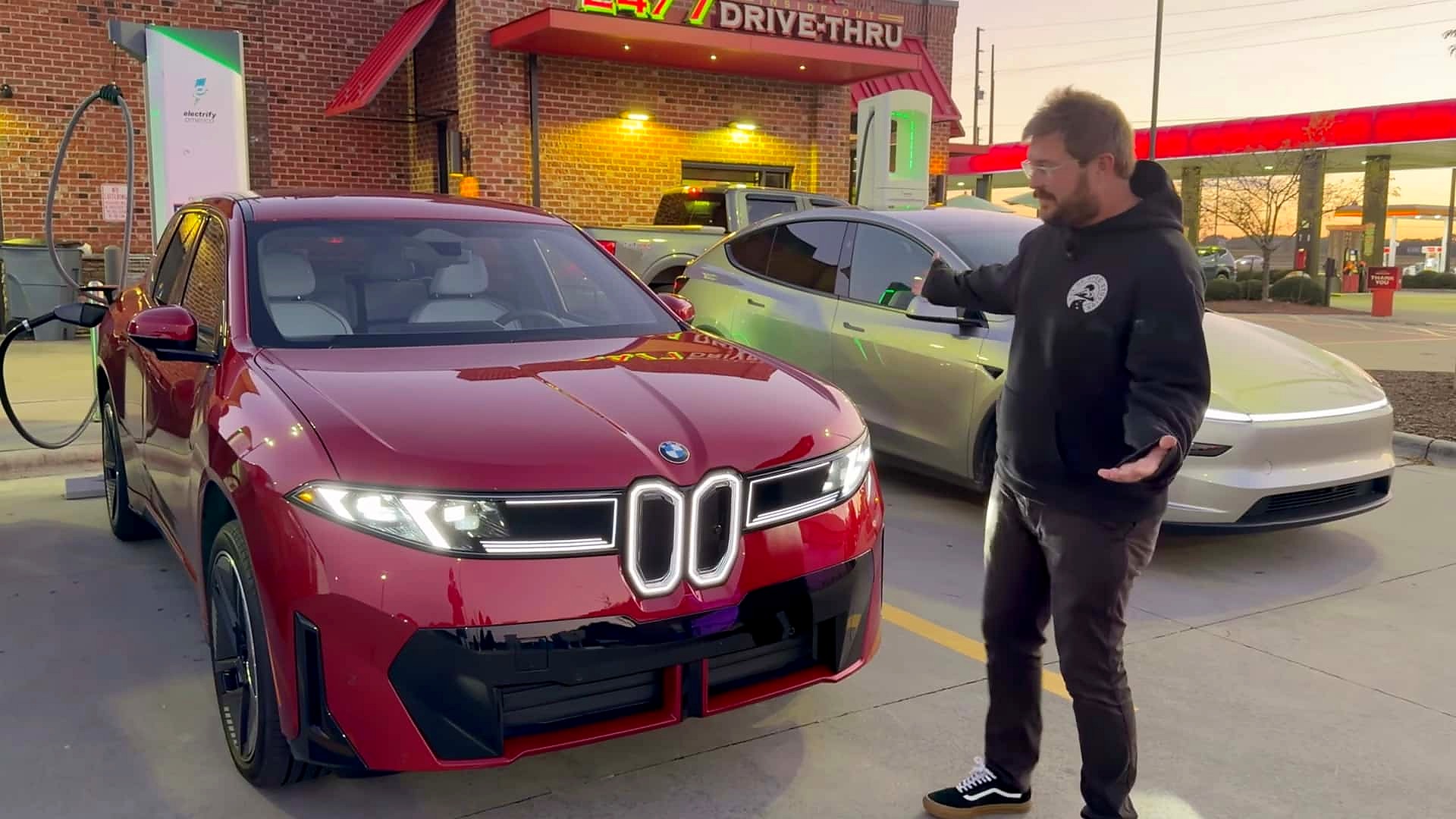
The BMW iX3 range test in North Carolina delivered a result that should worry every rival in this class. Out of Spec Testing ran four electric SUVs along U.S. Route 64 at a GPS-verified 70 mph. The BMW iX3 still showed 42 percent after 192 miles.
Each contestant started at 100 percent with warmed batteries, factory tire pressures and climate control running. None wore its most range-friendly wheels, so the numbers reflect real strain rather than marketing best cases. Even so, the iX3 handled the load better than anything else on the road. For more on how charging rivals are reshaping this space, read Tesla Thought It Owned EV Charging Forever on Auto News Magazine.
Inside the BMW iX3 range test
Battery size did most of the heavy lifting here. The iX3 carries roughly 112 kWh usable, while the Rivian R2 manages about 88 kWh. Meanwhile, the Model Y L sits near 85 kWh, and the Lexus RZ450e fades after just under 70 kWh. On paper, that gap explains almost everything.
| ⚙️Engine / Powertrain | Dual-Motor Electric (800V Architecture) |
| 🐎Power Output | 463 HP (est.) |
| ⚡Peak Torque | 645 lb-ft (est.) |
| ⏱️0-60 mph (0-100 km/h) | 0-60 mph in 4.9s (est.) |
| 🚀Top Speed | 149 mph (est.) |
| 🔄Drivetrain / Gearbox | Single-Speed AWD |
| 💰Starting Price / Est. | $70,000 (est.) |
Efficiency Champions Versus Brute Capacity
The Model Y L was the frugal standout. Despite its smaller pack and six seats, it covered 286 miles on 81.1 kWh. Its displayed efficiency hovered around 3.5 to 3.6 miles/kWh, comfortably ahead of the field.
The RZ450e posted 2.8 miles/kWh, but its modest reserve ran dry at 189 miles. Efficiency alone cannot overcome a small battery on a fast highway loop.
Why 800 Volts Still Matter
Ultimately, the BMW’s win was decisive. The iX3 reached zero near 333 miles, then kept rolling to 339.7 miles while consuming 112.7 kWh at roughly 3 miles/kWh. Its 800-volt architecture also accepted 122 kW immediately after depletion, effectively everything the mobile charger could supply.
According to BMW, the iX3 targets this kind of long-distance stability. Expect early used examples with 21-inch wheels to hold their value well, since range anxiety remains the biggest barrier for buyers. Still, the Model Y L proves that careful energy management can narrow the gap.
The BMW iX3 range test confirms that battery capacity and 800-volt charging still set the benchmark. The Rivian R2 and Lexus RZ450e have their strengths, but the iX3 sets the highway pace for now.

Julian Hayes
Future Mobility & Technology Editor at Auto News Magazine. Covering the next frontier of electric powertrains, 800V architectures, solid-state battery chemistry, and autonomous vehicle platforms.
View all articles by Julian Hayes →