
In 1997, Mercedes-Benz launched the first-generation A-Class as a practical city runabout. Stubby, economical, and utterly devoid of sporting pretense, it was never meant to challenge hot hatchbacks. Then HWA stepped in. According to a recent report by CARBUZZ.COM, this Stuttgart-based tuning house was commissioned to build something extraordinary: a Mercedes Hot Hatch that would rewrite the rulebook years before Mercedes-Benz itself got serious about performance A-Class models.
The Supercharged Sleeper Emerges
What HWA delivered was nothing short of automotive rebellion. The standard A-Class came with four engine options, the largest being a 1.9-liter four-cylinder. HWA ripped it all out. In its place went a 3.2-liter supercharged V6 borrowed directly from the SLK32 AMG and C32 AMG, producing 354 horsepower and 332 lb-ft of torque.
Fitting this engine required surgical precision. The dashboard shifted backward. Front seats moved rearward, sacrificing 2.8 inches of legroom. The subframe underwent extensive reinforcement. HWA initially explored a 500-horsepower V8, but packaging constraints killed that dream immediately. The V6 was the only realistic path forward.
| ⚙️Engine / Powertrain | 3.2L Supercharged V6 (SLK32 AMG sourced) |
| 🐎Power Output | 354 HP |
| ⚡Peak Torque | 332 lb-ft (est.) |
| ⏱️0-60 mph (0-100 km/h) | 0-60 mph in ~5.0 seconds |
| 🚀Top Speed | 170 mph (electronically limited to 155 mph) |
| 🔄Drivetrain / Gearbox | 5-Speed Automatic / Rear-Wheel Drive |
| 💰Starting Price / Est. | Custom one-off build (price undisclosed) |
Even the transmission came from the SLK32 AMG: a five-speed automatic. Nothing about this Mercedes Hot Hatch was off-the-shelf. Every component was either sourced from performance models or custom-fabricated to make the engineering work.
Rear-Drive Revolution In A Hatchback
Here’s where things get truly radical. The original A-Class was front-wheel drive. HWA converted the A32K to rear-wheel drive by borrowing the entire driveline from the SLK32 AMG. This wasn’t a simple bolt-on job. The suspension geometry, chassis stiffness, spring rates, and damper tuning all required bespoke calibration to handle the A-Class’s unconventional weight distribution.
Braking hardware came from the SLK32 AMG as well. Custom brackets and specialized brake lines were fabricated to make everything cooperate. At 170 mph, the A32K needed stopping power that matched its acceleration. The stock A-Class brakes were wholly inadequate.
Performance figures were genuinely impressive for 2002. The A32K launched from 0-60 mph in roughly 5.0 seconds flat. Compare that to the Ford Focus SVT of the same era, which needed nearly seven seconds. Electronically limited to 155 mph for German market compliance, the A32K’s true top speed was estimated at 170 mph.
The Sleeper That Time Forgot
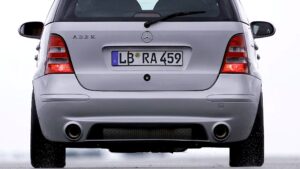
Visually, the A32K was deceptively understated. Wider fender flares hinted at the chassis work beneath. A revised rear bumper with dual chromed exhaust tips suggested something lurked within. AMG-branded wheels completed the subtle transformation. To the untrained eye, it looked like a mildly tuned A-Class. In reality, virtually every mechanical component had been gutted, upgraded, or completely replaced.
Mercedes-Benz never officially acknowledged the A32K. HWA was sanctioned by the brand, yet the company refused to claim this one-off as its own. It wasn’t until 2013 that Mercedes launched the A45 AMG, featuring a turbocharged 2.0-liter inline-four with 360 horsepower and all-wheel drive. The A45 represented a fundamentally different philosophy: smaller displacement, forced induction, and electronic traction control.
The A32K’s rear-drive, naturally aspirated supercharged approach was a sledgehammer compared to the A45’s precision scalpel. Yet Mercedes-Benz’s official history conveniently omits the A32K entirely. This one-off remains a fascinating footnote in performance hatchback evolution, a harbinger of what could have been if Mercedes had embraced the hot hatch segment a decade earlier. Like the future AMG GT SUV’s electric performance philosophy, the A32K proved that unconventional engineering can yield extraordinary results.
A Relic Worth Remembering
Today, the A32K exists as a singular artifact of automotive ambition. It was never mass-produced. It never spawned variants or successors. It simply was: a one-off commission that proved HWA could transform a humble city car into a genuine performance machine. In an era of turbocharged efficiency and all-wheel-drive traction control, the A32K’s rear-drive supercharged character feels almost rebellious.
Should this Mercedes Hot Hatch ever surface at auction, expect serious collector interest. One-off performance builds from respected tuning houses command premium valuations, particularly when they predate official manufacturer performance variants. The A32K’s historical significance as a precursor to the A45 AMG only amplifies its appeal to enthusiasts who appreciate automotive archaeology.

Liam Campbell
Industry Intelligence & News Editor at Auto News Magazine. Tracking prototype spy shots, Nürburgring development mules, automaker corporate moves, and breaking global automotive scoops.
View all articles by Liam Campbell →