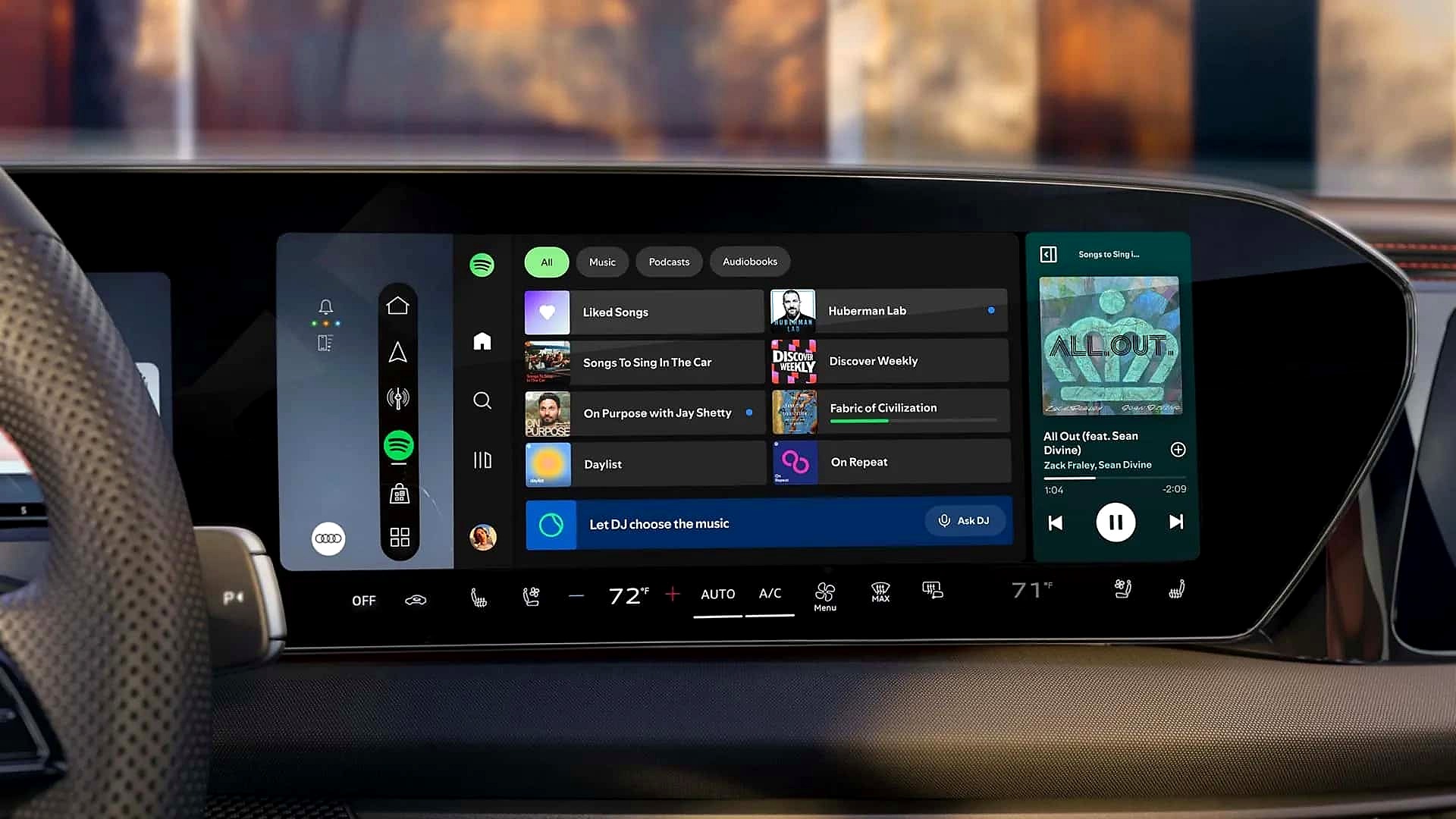
The Audi Spotify App marks a genuine shift in how streaming services live inside a cabin. According to a recent report by INSIDEEVS.COM, Spotify has finally escaped the template prison of Android Automotive.


Audi Spotify App Ditches Google’s Straitjacket
The previous Android Automotive build ran headless, so Google dictated every menu and button. The new headful architecture flips that equation, letting Spotify render its own interface from scratch. Software-first thinking like this mirrors the debate in our piece on Audi EV strategy, where the real battleground is code, not horsepower.
Passengers on cars with a second display can now view synced lyrics. They can also scan a QR code to join a shared listening session and feed songs into a common queue. Video playback locks out once the vehicle moves, which is sensible, though audio should never stutter during the transition.
Voice Control and Phone Projection Coexist
Voice commands plug directly into the car’s built-in assistant. Saying “Hey Audi” handles playback without touching the glass. Sign-in requires a smartphone to scan an on-screen code, but after that, the experience is fully decoupled from your handset.
Spotify still calls phone projection a priority, and Apple CarPlay and Android Auto remain on the menu. Even so, a native client that runs without a phone tether is the more interesting long-term play, and it is clearly the company’s direction.
Who Gets The Update First
Current availability covers the A6 e-tron and Q6 e-tron EVs, plus the A5, Q5, and A6 combustion models from model year 2026. Audi says the app will reach 47 markets across Europe, the Americas, Asia, Africa, and Australia. Updates arrive over the air through the Audi Application Store, so no dealership visit is needed.
On paper, the Audi Spotify App is an elegant software win for the automaker. In reality, it also raises the bar for every rival still relying on Google’s templates, and I expect other manufacturers to follow within a year. For more on Audi’s broader software direction, see Audi’s official website.
Ultimately, this rollout proves that streaming belongs inside the vehicle’s own architecture. Phone projection still has a place, but the cabin is finally getting an app that behaves like it was built for the car.

Julian Hayes
Future Mobility & Technology Editor at Auto News Magazine. Covering the next frontier of electric powertrains, 800V architectures, solid-state battery chemistry, and autonomous vehicle platforms.
View all articles by Julian Hayes →