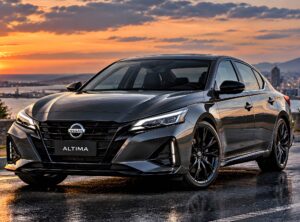
Nissan just pulled the trigger on the 2027 Altima and it’s not the resurrection story the automaker hoped for. After months of industry chatter suggesting the midsize sedan would be axed after 2026, Nissan doubled down, confirming the nameplate’s survival. However, the pricing strategy reveals a company caught between market realities and shareholder expectations. The base SV FWD now costs $29,065, a $210 jump from 2026. More critically, Nissan has eliminated all-wheel drive from the entry-level trim entirely, forcing cost-conscious buyers to the $30,465 SR if they want traction in winter conditions. This is not a confidence move.
The Pricing Trap Nobody Saw Coming
Here’s where the business case starts to unravel. The Kia K5, armed with a 186-hp 2.5-liter four-cylinder and a traditional eight-speed automatic, undercuts the Altima at $28,935. Furthermore, the Toyota Camry hybrid enters the ring at $30,955 with a staggering 51 mpg combined efficiency rating. The Altima’s Xtronic CVT maxes out at 30 mpg combined (FWD). Nissan is asking buyers to pay more for less efficiency—a fatal miscalculation in today’s segment.
Consequently, the numbers tell a brutal story. Through the first nine months of 2024, Nissan has sold just 56,424 Altimas, representing a 26% decline year-over-year. Meanwhile, Toyota has moved 260,684 Camrys over the same period. The Altima is hemorrhaging market share, yet Nissan’s response is to raise prices and restrict options. This is defensive positioning masquerading as product confidence.
| ⚙️Engine / Powertrain | 2.5L 4-Cylinder |
| 🐎Power Output | 188 HP (FWD) / 182 HP (AWD) |
| ⚡Peak Torque | 180 lb-ft (FWD) / 178 lb-ft (AWD) |
| ⏱️0-60 mph (0-100 km/h) | 0-60 mph in 8.2s (est.) |
| 🚀Top Speed | 130 mph (est.) |
| 🔄Drivetrain / Gearbox | Xtronic CVT / FWD or AWD |
| 💰Starting Price / Est. | $29,065 (SV FWD base) |
Engine & Transmission: Familiar, Not Exciting
The 2027 Altima carries forward the same 2.5-liter four-cylinder engine producing 188 horsepower and 180 lb-ft of torque in front-wheel-drive configuration. However, AWD models sacrifice 6 hp and 2 lb-ft, dropping to 182 hp and 178 lb-ft. The Xtronic CVT remains the sole transmission option. Acceleration figures are modest; expect 0-60 mph in approximately 8.2 seconds. In fact, this powertrain is now nearly a decade old, making it one of the oldest engines in the segment.
The SR trim adds 19-inch alloy wheels, gloss-black trim, and carbon-fiber accents. Front-wheel-drive SR models receive a sport-tuned suspension and paddle shifters. Notably, Apple CarPlay and Android Auto come standard across all trims, along with remote engine start. Optional upgrades include a 12.3-inch touchscreen infotainment system and wireless phone charging.
The Verdict: A Sedan In Slow Decline
The 2027 Nissan Altima is not dead, but it is dying. Nissan’s decision to raise prices while eliminating AWD from the base trim signals a brand retreating from volume competition. The Altima once challenged the Camry for midsize supremacy; today, it’s fighting for relevance against better-engineered rivals. Unless Nissan commits to a complete redesign—not merely a price hike—expect the Altima’s market share to continue its downward spiral. The sedan refuses to exit the stage, but the audience has already left the theater.

Liam Campbell
Industry Intelligence & News Editor at Auto News Magazine. Tracking prototype spy shots, Nürburgring development mules, automaker corporate moves, and breaking global automotive scoops.
View all articles by Liam Campbell →